

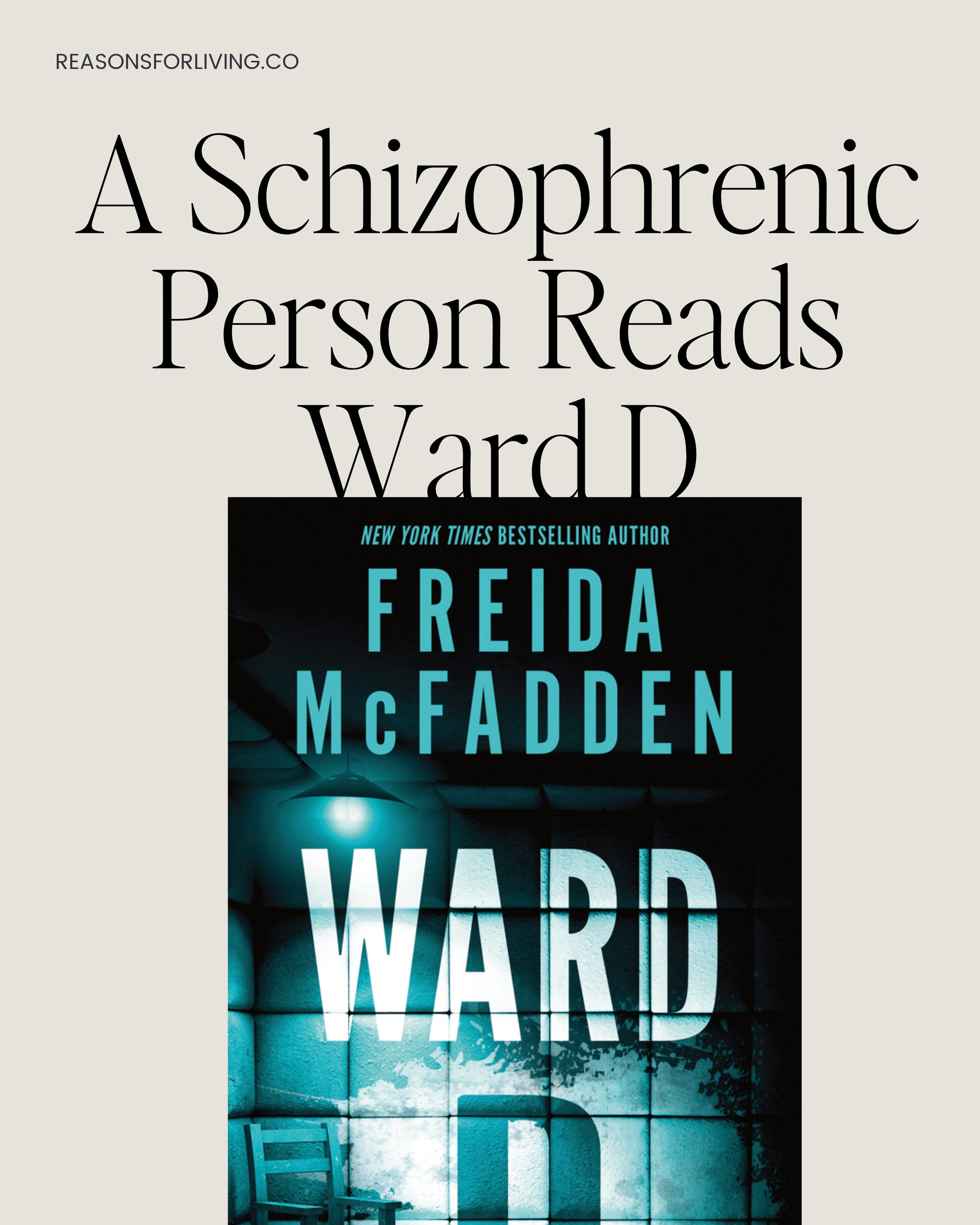
A Schizophrenic Person Reads "Ward D"
...and it goes about how you'd expect

A quick note: some of the links below are affiliate links. If you click through and buy something, I may earn a small commission—but I only ever share resources I've actually used and found valuable in my own writing life.
I write because it’s what I do best, and Reasons for Living is where I share my most personal, thoughtful work—the kind of essays that don’t fit anywhere else. If you enjoy what I write, I’d love for you to become a paid subscriber.
Paid subscribers get two exclusive essays per month. Your support doesn’t just help sustain this newsletter; it helps sustain me as a writer and artist who is physically and psychologically unable to work at a traditional job.
If Reasons for Living has moved you, challenged you, or given you something to hold onto, I hope you’ll consider subscribing. If a paid subscription isn’t possible, a free one is just as appreciated. Either way, I’m grateful you’re here.
Here’s something you should know about me: I love reading thrillers. I read good ones and mediocre ones and, if I really feel like filling my head with garbage, the extremely bad ones. I’ve read almost every book Frieda McFadden has written, and I’ve enjoyed most of them—including the Housemaid books, The Housemaid (2026), now a major motion picture starring Amanda Seyfried and Sydney Sweeney. The fun is in the twists you can see coming and, even better, the ones you can’t; the fun of reading a thriller is in the breakneck pacing that makes you read standing up in your kitchen at dinnertime because you just have to know what’s behind that previously locked door.
I’m not “above” thrillers. I am not “too literary” for thrillers. I’m telling you this so you understand that what follows is not a takedown from someone who arrived on the landscape cold, looking for reasons to be offended.
I am, however, a person with schizoaffective disorder. A person who has been involuntarily hospitalized three times. A person who wrote a book about it—The Collected Schizophrenias*, which became a New York Times bestseller and was named one of TIME’s 10 Best Nonfiction Books of 2019. (The brag is relevant here. You’ll see why.)
So when McFadden published Ward D in 2023—a locked-room thriller set on a psychiatric ward—I picked it up with trepidation. And, I’ll admit, with a smidgeon of hope.
The dedication reads: “for my patients.”
The acknowledgments thank a psychiatrist. And a sensitivity reader.
A sensitivity reader! That has to be a good sign. Right?
…Right?
Let me tell you what Ward D is about.
The premise: Amy, a medical student with her own, um, unattended issues, must spend the night working on Ward D—the hospital’s psychiatric unit. The book refers to it, every single time, as a LOCKED psychiatric ward, which is a phrase meant to maximize the reader’s terror. As though there exist psychiatric wards where patients come and go as they please. As though the locked door is the exceptional detail, the thing that makes this ward especially dangerous, rather than standard protocol on basically every inpatient psychiatric unit in the country.
I know this because I have been behind those locked doors three times. Nope, not as a medical student with a code to get out. As a patient. With no code. With no known discharge date. With leather restraints on my wrist and ankle because I had taken a minor overdose, and a nurse who threatened to put me in four-point restraints if I didn’t behave.
For me, the locked door was not a plot device. The locked door was my life. (With eggs made from powder at breakfast.)
But in Ward D, the locked door is Chekhov’s gun. The code Amy needs to get the hell out of Dodge is the thing that traps her with the lunatics. Will she make it out alive?
McFadden presents Amy as a ridiculously skittish protagonist, probably to serve as a contagion of fear to the reader. Amy is full of worries about what terrifying violence and bizarre behavior she might be forced to witness. And I’ll save you the suspense: the night ends in a truly ridiculous amount of bloodshed. There is, of course, a twist—the doctors are really the patients. If you didn’t see it coming, I can’t help you. Sorry.
There appear to be about four patients on the ward. I say “appear” because the rest apparently aren’t scary enough to be relevant to the plot. All of the featured patients are schizophrenic. One of them thinks he’s Superman, because of course he does.
Let me show you what 675,981 Goodreads readers rated a 4.0 out of 5:
A patient in seclusion makes a sound that the narrator describes as “terrible — barely even human. Something between a groan and a growl.” And then: “My God, who is in that room? Or should I say, what?”
What.
Not who. What.
A person in a seclusion room—a room I have been near, a room people I know have been locked inside—i.e., reduced in a single pronoun from human being to thing. To monster. To what.
There’s more.
A character casually diagnoses another person they consider a weirdo: “So he’s a schizophrenic then?”—as though schizophrenia is a punchline that requires no further investigation, a single word that tells you everything you need to know about a person’s capacity for violence.
The narrator reflects: “After all, if you meet someone who is truly mentally ill, that’s the only way to know that you’re sane.”
Let that one sit with you for a moment. If you meet someone who is truly mentally ill, that’s the only way to know that you’re sane. The function of madness, in this configuration, is to reassure the sane of their sanity. We exist so that you can feel normal. (You’re welcome.) Our suffering is your mirror.
The narrator encounters a patient who looks completely ordinary, and is disturbed by this:
“I had hoped to come in here and see a raving lunatic, but Will Schoenfeld looks completely benign. He could be absolutely anyone: some guy you passed on the street, a friend, a neighbor.”
Amy hoped to see a raving lunatic. Because a raving lunatic would be legible. A raving lunatic would make sense. Such a person would be reassuring in its recognizability. The terrifying thing is that the mentally ill person looks like a person.
Could be anyone.
Could be your neighbor.
Could be me.
Could be, if we’re being honest about the statistics, someone you love.
There’s a moment in the book where a patient plays the piano beautifully, and the narrator thinks:
“It’s sad that somebody with so much talent had their brain crap out on them like that, but isn’t that what they say? That people with incredible talent are more susceptible to mental illness? Or maybe I just made that up.”
Their brain crap out on them. The casualness of it. The breezy, almost cheerful reduction of a neurological condition to a mechanical failure — like an engine refusing to start, or like a phone screen cracking. Their brain crap out on them. This, in a book dedicated “for my patients.”
And let’s not forget about the seclusion room, which I mentioned earlier: “Let… out.” The narrator describes the voice as “like a hiss.” Like “somebody talking with a mouth full of marbles.”
“Let… me… out…”
I have a particular relationship with those words. In a psychiatric hospital, getting out is a sacred concept. Discharge is the word you orbit. You count the interminable hours, the interminable days. You watch people who checked themselves in voluntarily leave as easily as checking out of a hotel, and you, the involuntarily committed, stay, and you stay, and you stay. The words let me out are not a horror-movie hiss. It is the most painfully human sentence a person can speak from inside a locked room.
But in Ward D, those words are set dressing for the spooky. Atmosphere. It’s the creepy hiss from behind the door that makes Amy’s skin crawl, that makes the reader turn the page faster. It’s the inhuman version of what used to be human that functions the way a creaking floorboard functions in a haunted house tale.
Except here, the haunted house is a hospital. And the ghosts are patients.
And then, inevitably:
“Miguel is standing in the middle of the hallway, stark naked, streaked in blood.”
There it is. The first truly terrifying image the whole book has been building toward. The blood-streaked madman! The naked body in the corridor! The spectacle of psychosis is rendered as a set piece, as a big scare, as the thing that justifies every locked door and every terrified flinch Amy makes.
Close to the end, Amy receives the gaze she’s feared all along: “Dr. Beck is staring at me. He’s looking at me in a way that I have never wanted to be looked at. In a way that I have always feared. Like he thinks I’ve lost my mind.”
Because, dear Reader, the worst thing that can happen to Amy is not violence. Nope. It’s not death. The worst thing is being looked at the way we are looked at. Being seen the way the mentally ill are seen. The horror of the book is not the ward. The horror is the possibility of belonging there.
During my second hospitalization, a nurse asked me how I was doing.
“Okay,” I said.
She smiled. “But how are you *really* doing?”
“I’m really doing okay.”
My medical notes later read: “Patient shows lack of insight.”
A primary feature of staying in a psychiatric hospital is that you will not be believed about anything. A corollary: things will be believed about you that are not at all true. I told a doctor I was a writer and had studied psychology at Yale and Stanford, and the believability of that was akin to saying I was an astronaut. I later trounced the other patients in a mandatory word game, which was childish, but I was tired of being treated as though I were stupid.
This is what I know that Ward D doesn’t: the people on the ward are people. There was Mara, who stole my coat in the cafeteria line and my pillow while I slept—not out of malice, but out of some quiet, unnameable compulsion. The young man who called me Lois Lane because I wouldn’t put down my notebook. The patients who were groggy from medications and uncommunicative, sitting by the television in the particular stillness of the heavily sedated, drugged up on Clozaril and Seroquel and Zyprexa and Risperidal.
None of them were monsters. None of them were what instead of who. None of them were plot devices.
They were people whose brains worked differently, in a building with locked doors, eating reconstituted eggs with plastic spoons, counting the hours until someone with authority would say: you can go.
That’s all.
I keep coming back to the sensitivity reader.
Someone was hired to read this book—a book in which a person in seclusion is called a what, in which schizophrenia is shorthand for danger, in which the worst fate imaginable is to be mistaken for one of the patients—and that person said: Sure. This is fine. This passes under my standards.
675,981 readers gave it a 4.0.
I don’t know what to do with that. I don’t know what to do with the knowledge that in 2026, a book can be dedicated “for my patients” and then use those patients as jump scares. That same book can acknowledge the existence of sensitivity readers and still reduce psychosis to chaotic spectacle.
Maybe the sensitivity reader flagged things. Maybe the original draft was worse. I don’t know. (I really hope so, in a perverse way, although I find it truly hard to believe it.)
What I know is this: every time a bestselling thriller treats a psychiatric ward as a haunted house full of ghouls, it gets a little harder for people like me. It gets a little harder to tell someone you’ve been hospitalized. When you want to ask for help, there becomes that little nudge that says, No, you don’t want to become the what. And once you’re inside, there’s an unquantifiable amount of shame in your heart because you can no longer believe that the locked door is there to keep you safe rather than to keep the world safe from you.
The word asylum used to (and still does) mean shelter. A place of safety for the afflicted. It became a word that conjures horror because we made it one through the real brutality of institutional treatment, yes, but also through the stories we tell about the people inside.
Ward D is, unfortunately, one of those stories. It is not the first. It won’t be the last.
But I need you to know: if you read it, if you enjoyed it, if you rated it a 4.0—that the people behind those locked doors are not your entertainment. They are not your haunted house. They are not your twist ending.
They are people like me. Eating unidentifiable brown mush with plastic spoons. Counting the hours. Hoping the nurses will look at them and see a who. ❤️
If you want to understand what psychiatric hospitalization actually looks like—not the thriller version, but the human one—The Collected Schizophrenias is available wherever books are sold.
And if you’re a writer navigating mental illness or any other limitation, the acclaimed The Unexpected Shape Writing Academy, for ambitious writers living with limitations, was built for you. Not despite your experience. Because of it. Learn more here. Sales close forever on June 15.
I write because it’s what I do best, and Reasons for Living is where I share my most personal, thoughtful work—the kind of essays that don’t fit anywhere else. If you enjoy what I write, I’d love for you to become a paid subscriber.
Paid subscribers get two exclusive essays per month. Your support doesn’t just help sustain this newsletter; it helps sustain me as a writer and artist who is physically and psychologically unable to work at a traditional job.
If Reasons for Living has moved you, challenged you, or given you something to hold onto, I hope you’ll consider subscribing. If a paid subscription isn’t possible, a free one is just as appreciated. Either way, I’m grateful you’re here.
Yikes! That’s fucking vile.
Kind of wonder if the sensitivity reader raised some of these issues and the author just ignored the feedback.
I had to look up this author because I'm nosy and have opinions about doctors based on their specialties. (It's not universal, but there's definitely Types of Guy that are attracted to each one.)
First: horrified that this woman lives in proximity to me and of course is an assistant professor at Tufts. Ew. Gross. 0/10. Also not surprised that both of her parents were doctors and that she went to Harvard for undergrad.
Second: shattered that she's basically a physiatrist who helps people with brain disorders regain function. Not only is that an incredibly delicate position to be in as a patient with a vile doctor, but physiatrists aren't generally known to be the raging assholes of the medical field due to their more holistic approaches and proximity to PTs and OTs. What must she think of her struggling patients? Does she find them as disgusting as she clearly does psychiatric patients? Or are their ailments "acceptable" because they're (probably) classified as neurological and not psychiatric? (SO many conditions are under the purview of both, and some have crossed over from psychiatry to neurology as we've gained further understanding of them...)
I'm also just...SO curious about the sensitivity reader. Are they bound by an NDA to not come forward and criticize the book if the author ignored their suggestions? Are they just as unscrupulous as the author herself? Who the hell is this person whose existence and involvement is being used as a shield against critique? I don't know much about the innards of the publishing industry, so maybe some of this is just common knowledge, but sheesh.
I'm grateful for you writing this and speaking out. People, whether professionals or amateurs, are truly their worst selves in the reviews of books involving mental illness. I once read an amazing, gripping graphic memoir (The Third Person by Emma Grove) that had many shit reviews on Goodreads because people had the gall to type "I didn't think the trauma she divulged was bad enough to cause DID" and "it wasn't as dramatic as I wanted it to be given the topic of DID." Who are the real "monsters" here??