

Seeing Good
On visibility, grief, and action

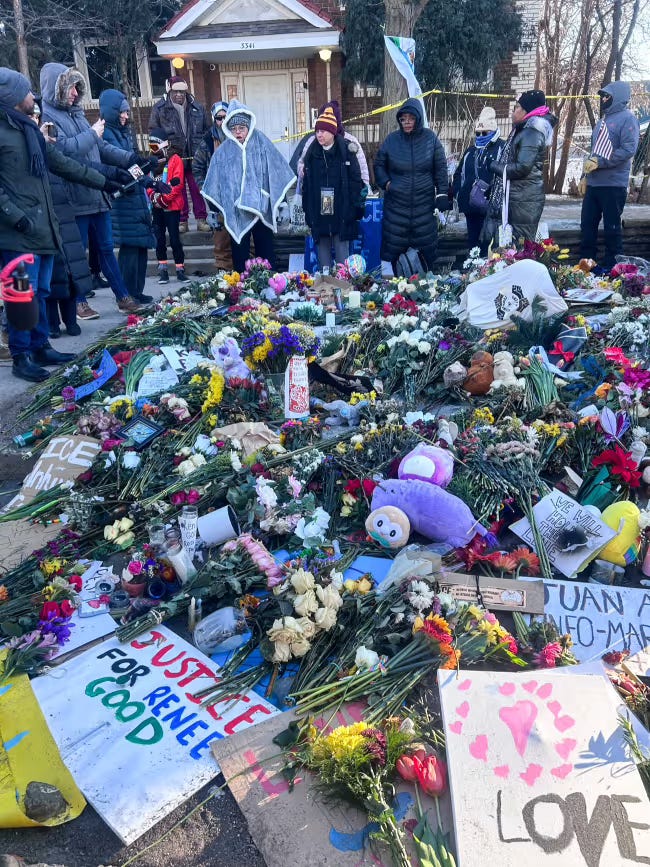
I’ve been thinking about how we can see good in this world. And how we can make more good happen in this world. There’s a not-small difference between the two. One is about making goodness occur; the other is about making that goodness visible.
Like many, I’ve been thinking about Renée Nicole Good. I’ve been thinking about the impact of her death on the public perception of ICE and what’s being done not only in Minneapolis, but in other impacted cities and towns as well.
Before she became a household name, Renée was a 37-year-old poet and writer and wife. She had three children. Her award-winning poem, “On Learning to Dissect Fetal Pigs,” ends with lines that have been circulating since her death:
all my understanding dribbles down the chin onto the chest & is summarized as:
Life is merely / to ovum and sperm / and where those two meet / and how often and how well / and what dies there.
On January 7th, Renée had just dropped her son off at school. She was driving home through their south Minneapolis neighborhood when she encountered ICE agents. What happened next has been captured on video, disputed by officials, and witnessed by neighbors (as well as her own wife, Rebecca). What’s not disputed: an ICE agent shot her three times through the windshield of her maroon Honda Pilot.
In the video, you can hear her say to the agent: “I’m not mad at you, dude.”
She died less than a mile from where George Floyd was murdered in 2020.
As I’ve been thinking about the enormous response to Good’s death, I wonder: is it worth it to complain about the stories not told, or is it enough to be glad that people are galvanized in this moment?
I sit with this tension because Renée was a beautiful white woman, one whose now-famous image reminds me of Sarah Snook. Renée’s story has been taken up by major news outlets, by writers and poets sharing her work, and by vigils and marches of thousands. A (now closed) GoFundMe for her family has raised over a million dollars. The nation mourned her. Even her last name seemed to call for a kind of natural response—she was Good! In all senses of the word!
And I am glad. I am glad people are galvanized because to not be galvanized is worse. I am glad people know her name. I am glad her poetry is being read. I am glad that her death has illuminated what ICE has been doing to communities of color for as long as the agency has existed, an act committed by the Department of Homeland Security in 2003.
But I also think about the many people affected by ICE whose stories are not being told. In 2025, Silverio Villegas González was shot and killed in a Chicago suburb; Josué Castro Rivera, from Honduras, was run over by a pick-up truck during an ICE traffic stop. Somali Minnesotans have been the focus of a targeted deportation campaign since late November, even though the vast majority are citizens or legal residents. There are tremendous numbers of impacted families of the roughly 2500 people who’ve been arrested in Minneapolis since Operation Metro Surge began. Eight restaurants have closed “until further notice”—Casa Iberica, La Loma Tamales, Don Papi Chulo’s, and others—and other restaurants are limiting their hours for weeks to come, their owners too afraid to leave their homes.
According to The Guardian, 2025 was ICE’s deadliest year on record, with twenty-five people dying in ICE custody.
When I look online, I see the comments. (I inevitably look at the comments despite common wisdom.) People with red hats and American flags as their avatars repeat what our president has said—that Renée was a terrorist, someone who tried to run over an ICE officer. The witnesses and the video don’t seem to matter.
I saw a person on Substack Notes call George Floyd “a waste of skin.” To say that Good looks a whole lot better with “three more holes in her face.”
I tell myself these are bots. It’s terrible to think of them as real people. But some of them are real, and they say such vile, heartless things that I feel what I’ve long called the most dangerous feeling: despair. Despair is knocking on our windows. It wants to climb into bed with us, probing with long tentacles, trying to convince us that there isn’t anything to do now that things are and have gotten this bad.
And yet there is also so much good being done.
In Minneapolis, neighbors have formed watch groups, coordinating to track federal immigration officers, sharing license plate information and locations. They observe when agents try to detain people, arriving nearly immediately—honking horns, blowing whistles, filming. The system is both highly organized and decentralized, with no clear leaders. Just longer-time members helping newcomers learn.
Elle Neubauer and her wife patrol their south Minneapolis neighborhood in the early mornings, looking for ICE vehicles to follow and observe. When agents came to their house and banged on the front door while Elle was out on patrol, her wife pretended she wasn’t home. The agents left after neighbors stepped out of their houses and started blowing whistles. (The whistle-blowing tactic has been ongoing, warning people of ICE in the area.)
Wrecktangle Pizza raised over $83,000 for nonprofits supporting affected families. When ICE agents tried to enter the restaurant, employees and community members chased them off.
The Black Immigrant Collective, a Black-led organization in Minnesota, is working at the intersection of Blackness and immigration—running legal clinics, providing mutual aid, and supporting undocumented Black immigrants. Unidos MN, a grassroots organization born from the DREAMER movement, is organizing for a Minnesota where everyone’s dignity is honored. The Immigrant Defense Network has brought together over 90 organizations to protect immigrant communities across the state.
Lyz Lenz, a friend who writes the newsletter Men Yell at Me, organized a team that ran 339 miles across Iowa to raise money for the Iowa Abortion Access Fund and Trans Mutual Aid. Her upcoming book, The Middle Kingdom, is about the Midwest’s culture of “mutual aid and stubborn care.” She models what it looks like to do good work in red-state America, to find community and build it where you are.
Pow Wow Grounds in Minneapolis is accepting donations to meet community needs. Joyce Uptown Foodshelf is hosting emergency food drives to meet skyrocketing demand for families who can’t leave their homes. Neighbors in southwest Minneapolis and Longfellow are fundraising to support rental assistance, food delivery, healthcare access, transportation, and legal services.
Thousands of people have signed up for legal observer trainings—so many that all sessions through January are at capacity, and I hope that they continue to sign up long after Good’s murder ceases to take up the front page.
But so much more is happening, too. And the “so much more” means so many things. What’s happening in Gaza. What’s happening in Venezuela. What’s happening to the Somali American population. What’s happening in Minneapolis.
This is not the story of one city undergoing Pulitzer-worthy photojournalism. This is the story of all the things that make despair crawl into our souls. And yet I return to Renée’s poem, where she wrote about being told by books like the Bible, the Qur’an, and the Bhagavad Gita—to make room for wonder. (I’d add many other books to that list, many of which are written by literary ancestors and by friends.)
We can’t control whose stories get told. I was told by a frustrated peer that their efforts to raise money for a non-white family targeted by ICE couldn’t make their goal of $15k, a fraction of the million-plus dollars donated to Good’s family. And we can still work to make good visible and most of all, to make good happen, showing up for our neighbors with whistles and food and translation services and legal observer training, and we can follow the work that’s already being done by organizations led by the communities most affected.
Renee’s wife Rebecca wrote: There is kindness in the world and we need to do everything we can to find it where it resides and nurture it where it needs to grow.
Let’s do that, please, for the sake of all that we love. ❤️
What You Can Do
Support the families directly affected:
Mutual aid fundraisers for detained families in Minnesota (search “Minnesota immigrant mutual aid” for current campaigns)
Support the organizations doing this work:
Black Immigrant Collective (blackimmigrantcollective.org) — Black-led organization providing legal clinics, mutual aid, and policy advocacy
Unidos MN (unidos-mn.org) — Grassroots organization building power with working families for social, racial, and economic justice
Minnesota Immigrant Rights Action Committee (MIRAC) (miracmn.com) — All-volunteer grassroots organization led by BIPOC and immigrant community members
Immigrant Defense Network (immigrantdefensenetwork.org) — Network of 90+ organizations protecting immigrant rights in Minnesota
Black Alliance for Just Immigration (BAJI) (baji.org) — National organization at the intersection of immigration justice and anti-Black social structures
Support local mutual aid:
Twin Cities Mutual Aid (twin-cities-mutual-aid.org)
Pow Wow Grounds (accepting donations for community needs)
Northern Coffeeworks (supporting weekly food deliveries to immigrant families)
Witness & tell stories.
Share what you see. Document what is happening. Tell the stories of the people doing this work.

The index card method everyone asks about—now available alone
I’m genuinely excited to tell you this.
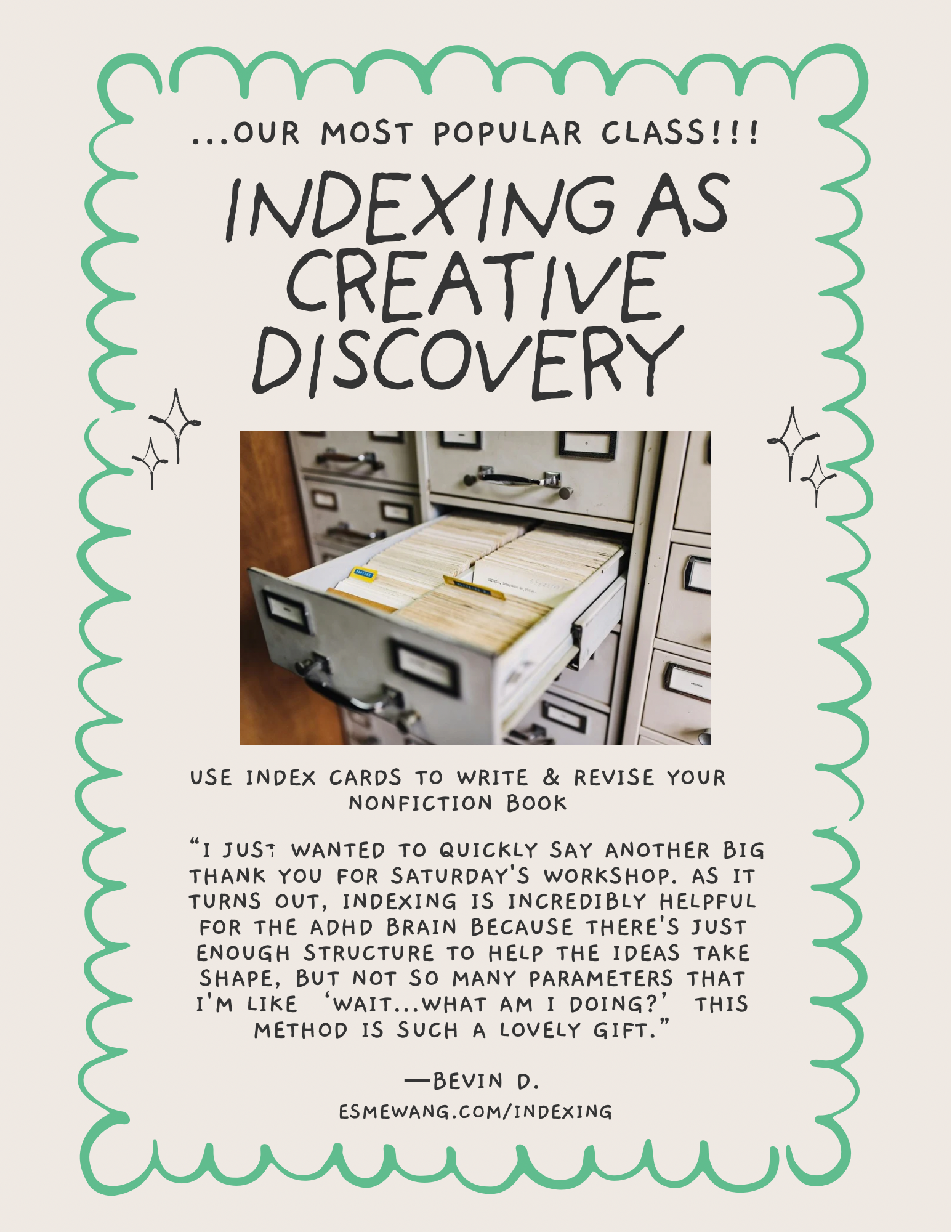
My most famous class, the one people ask me about constantly, the one that’s been locked inside The Unexpected Shape Writing Academy since 2021—Indexing as Creative Discovery is finally available as a standalone class again, to be taught live on January 30 (but available as a recording if you can’t make it). PLUS: office hours for any questions you might have.
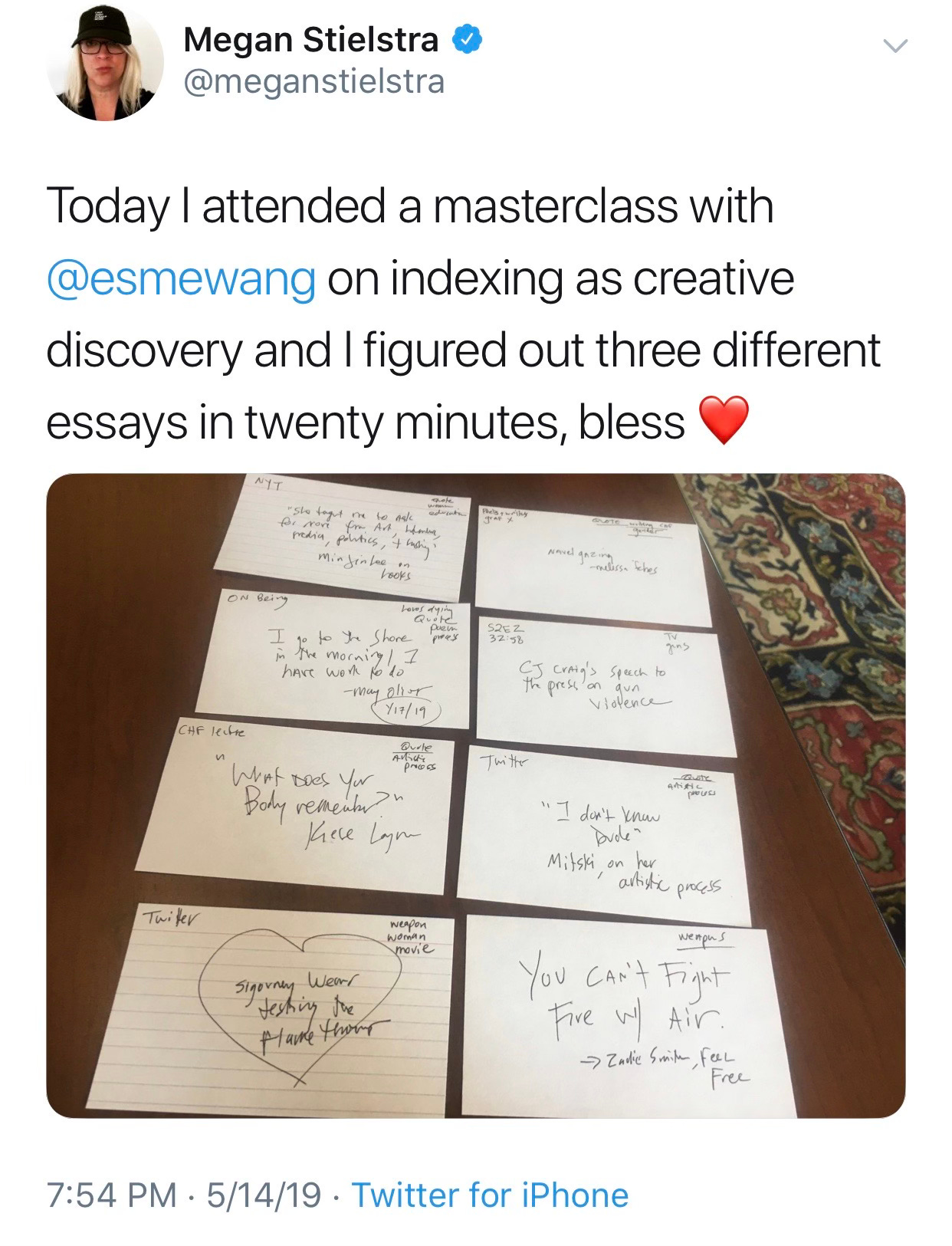
This is the index card method. The one that changed how I write everything. The one that gets mentioned in interviews and writer group chats and “hey, I heard about this thing you do with notecards?” DMs (for real).
I haven’t offered it separately in over three years because it’s such a core part of the Academy. But I kept getting the same question: Can I just take the indexing class?
So: yes. Now you can—and after January 28, it’ll go back into the lockbox for Academy members only.
And if you’ve been sitting on fragments—notes app entries, voice memos, journal pages scattered across years—this is exactly where to start.
Can’t make the live class? We’ll be giving access to the recording to everyone who registers. See more details here: https://www.esmewang.com/indexing
“I just wanted to quickly say another big thank you for Saturday’s workshop. As it turns out, indexing is incredibly helpful for the ADHD brain because there’s just enough structure to help the ideas take shape, but not so many parameters that I’m like, ‘Wait…what am I doing?’ This method is such a lovely gift.”
Bevin D.
Thanks for this. I am from Minnesota which, as you know, is under siege. Your comments remind me of a conversation I had this week with a Somali friend. I told her that the past week has truly shaken my faith in humanity. She said it has RESTORED her faith in humanity as everyone she has talked to is someone wanting to help. Hope.
Thanks for writing this. It’s clear, compassionate, brave, practical, necessary, and hopeful all rolled into one essay.